Is it worth repairing?
Is it worth repairing an old sewing machine?
This is a completely natural question to ask – especially when the cost of repairing an old sewing machine can be higher than the price of a new "budget machine". What is often overlooked is that these new machines are at the very bottom of the quality and price range.
Many older sewing machines were originally sold as solid quality machines, not as low-cost products. Taking inflation and purchasing power into account, many of these machines correspond today to a new sewing machine in the range of around NOK 20,000. Seen from that perspective, repair rarely appears to be a poor choice – quite the opposite.
But to answer properly, we look at two sides of the matter.
1. What value does the sewing machine have for you?
For many, a sewing machine is much more than a tool.
It may be the machine you inherited from your mother or grandmother.
The one you bought with your very first salary.
Or perhaps a wedding gift that has followed you for decades.
A sewing machine is not just a sewing machine.
It is history, memories – and a machine you know instinctively and feel comfortable with.
Replacing it with a new one does not just mean buying something else, but having to learn an entirely new machine. For many, part of the joy of sewing disappears right there. Therefore, the desire to repair is completely natural.
But then comes the next question.
2. What is the value of a 40–50-year-old sewing machine that "has started to break down"?
When the machine starts to misbehave, it can quickly feel like the end:
- Smoke comes from the motor
- It starts by itself
- Buttons are stuck and difficult to turn
- The mechanics feel stiff or completely seized
It is easy to think:
"Well, that was the end of it?"
And further:
"If I repair this – won’t new problems just appear soon?"
These are completely logical questions, especially when the machine is 40 or 50 years old.
Experience from repairing "everything"
I have repaired most things:
old TVs and radios, video players, washing machines, dishwashers, refrigerators, irons – in addition to cars and larger mechanical equipment.
From that experience, I can say one thing with great certainty:
Sewing machines are the product where I have seen by far the greatest quality difference between old and new.
I have had countless sewing machines in that have not been serviced for 40–50 years – and which are in practice not broken.
They just do not work.
In the vast majority of cases, the problems are caused by grease and oil that have degraded over time and hardened into a sticky mass. This leads to increased friction, stiff mechanics, and in many cases complete mechanical seizure. It is rarely a matter of actual wear or damaged components.
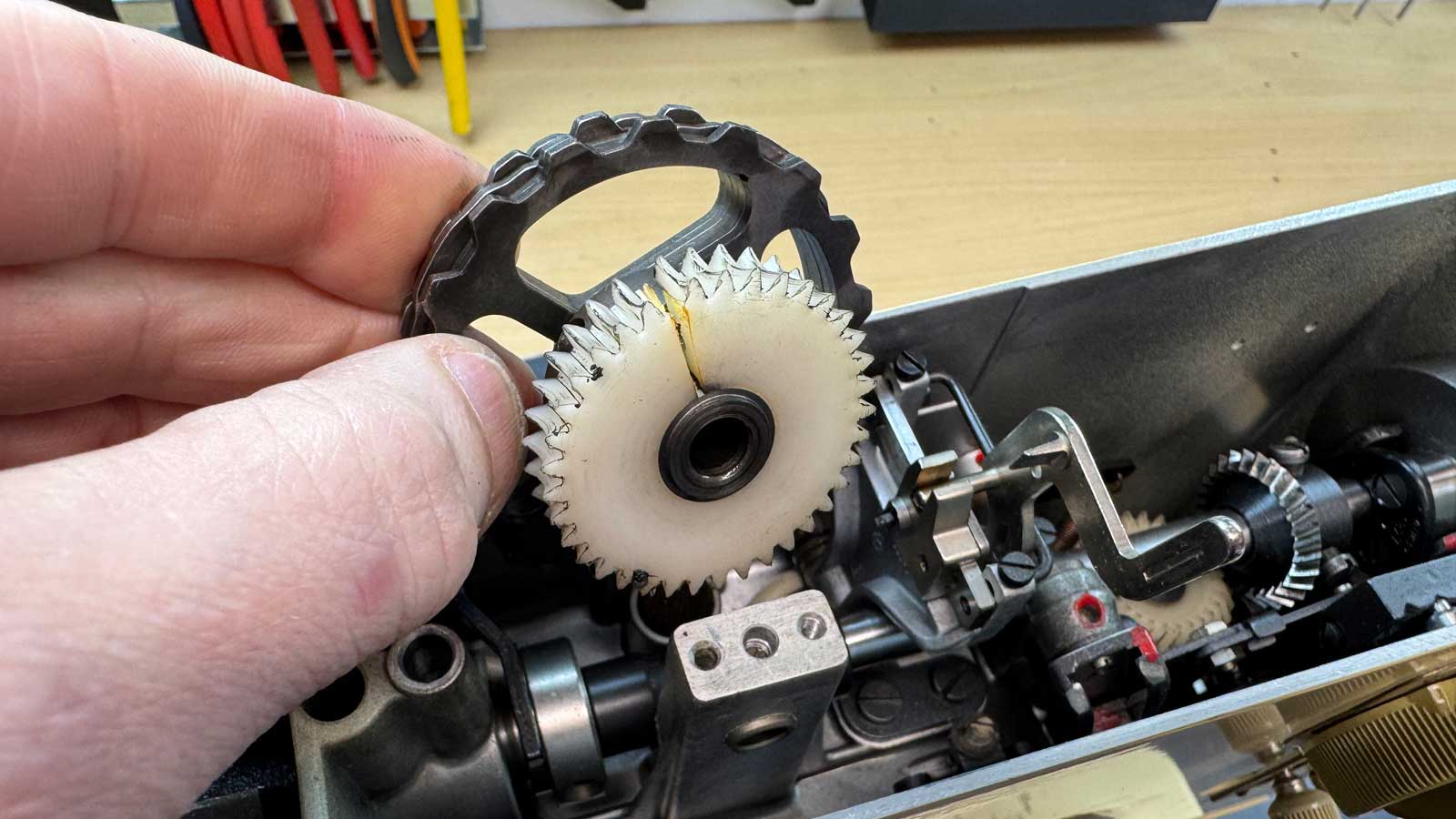
When the machines are disassembled and the old oil is thoroughly removed, it is striking how little mechanical wear is actually visible. Gears, shafts, bearing points, and sliding surfaces often appear mechanically almost like new.
After proper cleaning, new lubrication with modern oil that does not harden over time, and necessary adjustments, the machine in practice works like new again. Based on experience, I am confident that such machines have the potential to function just as well for many decades to come.
The fact that these machines are also designed to be disassembled, maintained, and repaired means that their lifespan is in practice only limited by access to professional expertise – not by the machine itself.
Repairability: then and now
Sewing machines produced up until the 1990s were made to be repairable.
- Yes, some models have nylon gears or certain plastic parts
- But the amount of plastic is limited
- Several of these parts are still produced by third-party suppliers – in good quality
From the mid-1980s, more electronics were introduced into sewing machines.
This did not come at the expense of mechanical quality.
On the contrary:
- The electronics in these machines are often far more repairable than in today’s machines
- Components are still being produced
- And where original components are no longer available, there are usually good replacements
Only very specific, brand-dependent electronic parts can be difficult to obtain – and then mostly only via so-called "donor machines".
Fortunately, it is very rare for these components to actually fail.
So – is it worth it?
My answer to both sides of the question is clear:
1. Yes, it is worth it.
A sewing machine with emotional value is always worth repairing.
2. Yes, it is worth it.
A sewing machine that is 40+ years old is built to a quality that surpasses most of what is sold new today.
If you consider that the lifespan after service is often several times longer than that of a new machine, the calculation actually becomes quite simple.
Based on experience, I would say that a well-maintained older sewing machine can easily have 4–5 times longer remaining lifespan than a new one – as long as there are professionals who can provide service and maintenance.
And there still are.