Restoration
What is the difference between restoration and service/repair?
A natural question many people ask is:
"When I deliver an old sewing machine that does not work – isn’t it just repaired and serviced before I get it back?"
The answer is both yes and no.
Restoration – more than just service
A restoration always includes service, and often also repair, but it is primarily a much more thorough process. The main goal is to bring the sewing machine back to optimal technical condition – as it functioned when it was new.
The main problem with most older sewing machines is not wear or broken parts, but old grease and oil. In the past, animal-based greases and oils were used, which over time have become thick like syrup or have completely hardened. The result is that moving parts seize. Springs are unable to return the mechanism to its starting position, and the machine simply does not work – even though all parts are actually intact and in good condition.
In many cases, damage occurs afterwards, when one tries to force stuck knobs and wheels.
This makes restoration something completely different from a regular service or repair.
Temporary solutions vs. lasting results
It is often possible to get an old sewing machine running again by heating the mechanism and spraying in products such as 5-56 or WD-40 (which should never be used as lubricants in a sewing machine). The machine may then work – for a while. The problem is that the old grease is still present in the mechanism. It has not been removed, only temporarily softened.
The question therefore becomes: How long will it last?
No shortcuts in restoration
In a restoration, no shortcuts are taken.
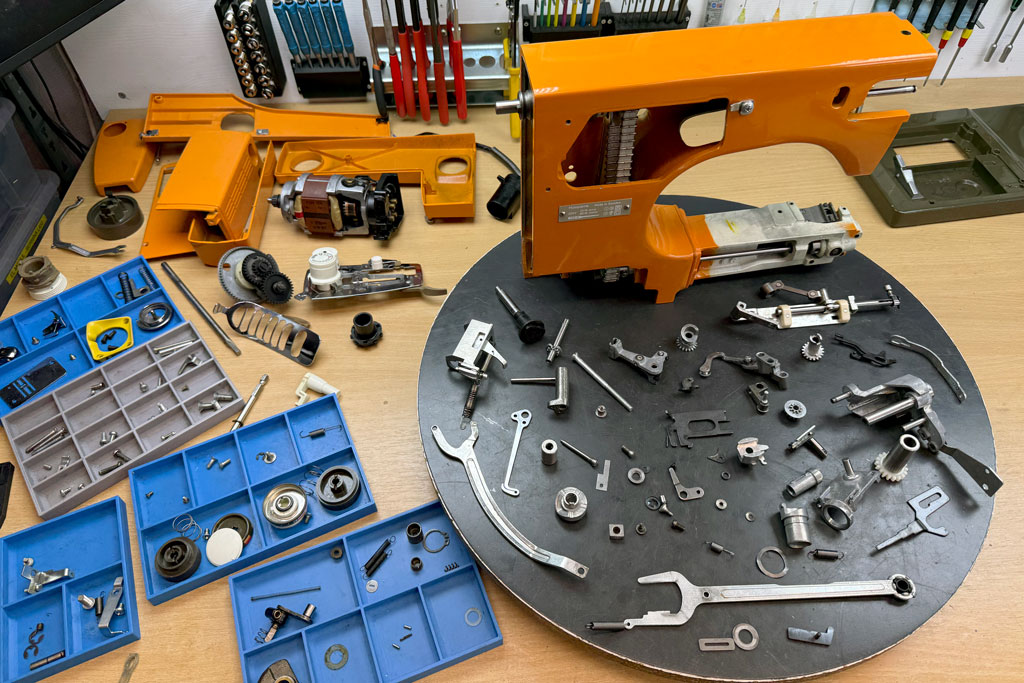
The sewing machine is disassembled as far as necessary. Mechanical parts are completely taken apart, and gears and components are thoroughly cleaned in an ultrasonic cleaner – the same type of equipment used in car workshops, by watchmakers and goldsmiths to remove oil, grease, and dirt.
When the parts are completely clean, they are lubricated again with the correct oil and grease before the machine is reassembled, adjusted, and tested. The result is a mechanism that moves smoothly and precisely – as it should.
If parts are damaged, they are either sourced from third-party manufacturers who still produce spare parts, from our own donor machines, or we manufacture the parts ourselves.
Wear parts and review of the electrical system
When the mechanical work is finished, the electrical system is reviewed:
- The motor is cleaned and lubricated
- Brushes are checked and replaced if necessary
- The commutator is polished
- Belts are checked and replaced if necessary
- In most machines, a new suppression capacitor and a new LED bulb are installed
This ensures both reliable operation and long lifespan.
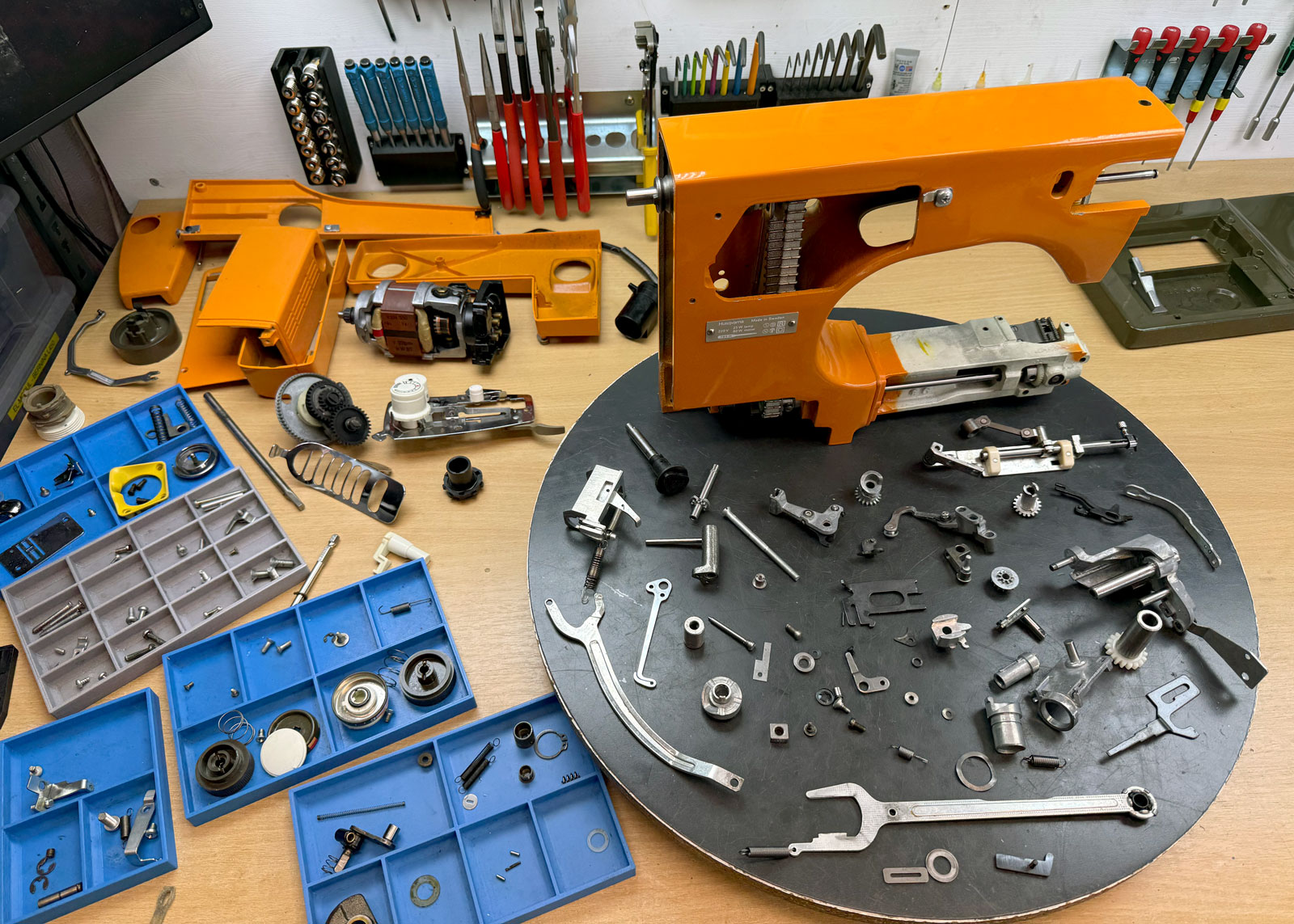
Restoration of a Husqvarna 6440
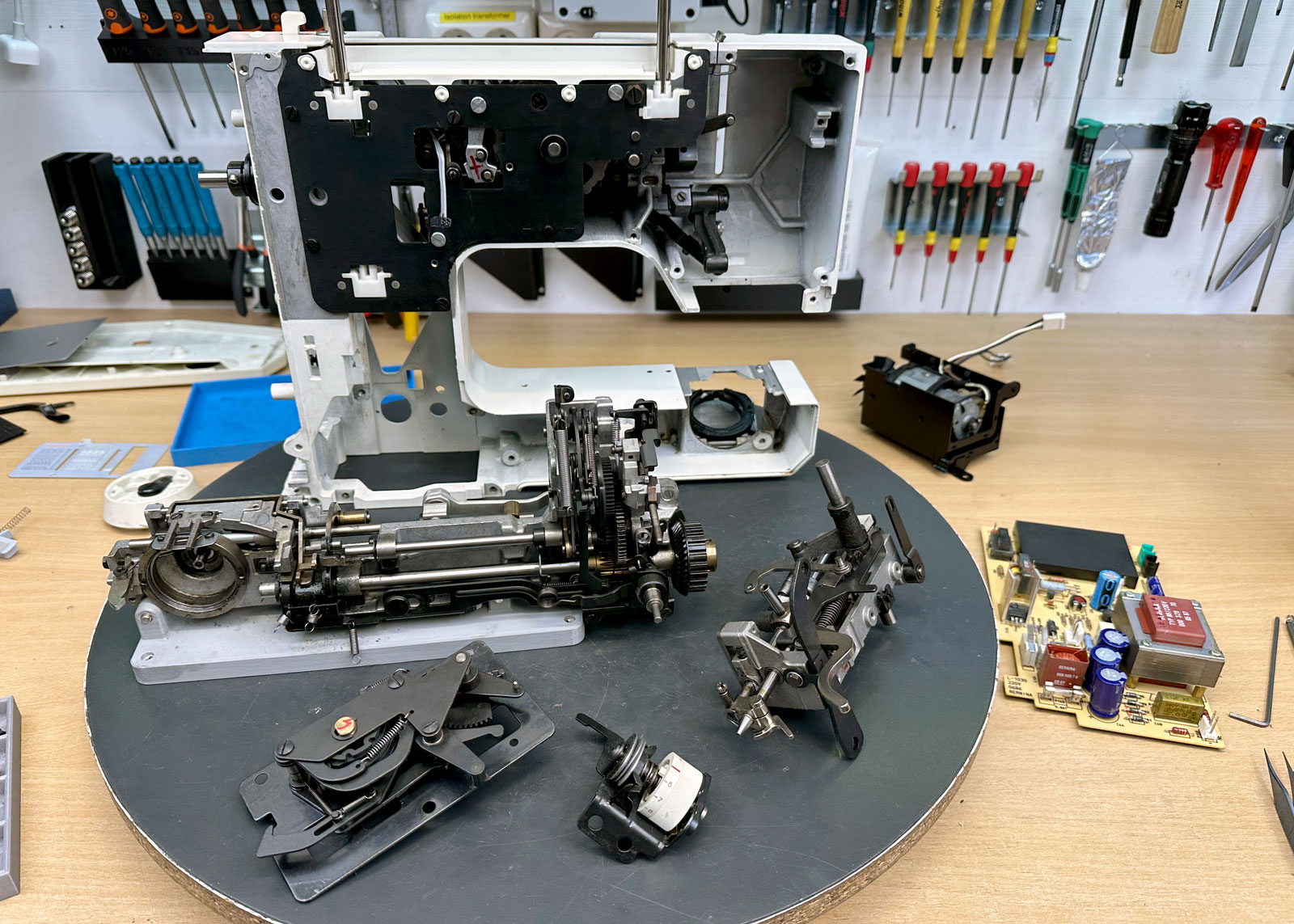
Restoration of a Bernina 1030
An investment in quality
A full restoration is a time-consuming and meticulous job that takes several hours, and is therefore more expensive than a regular service. In return, you get a sewing machine that is practically “like new” – and which will often last several times longer than a modern new machine.
These older sewing machines are built with a quality much closer to industrial machines than today’s consumer models. They are rarely mechanically worn out, and with proper restoration, they can function problem-free for many decades to come.