Restarters Norway
Organizes repair events and other great activities.
restartersnorway.no
We currently have a waiting time of 3 months.
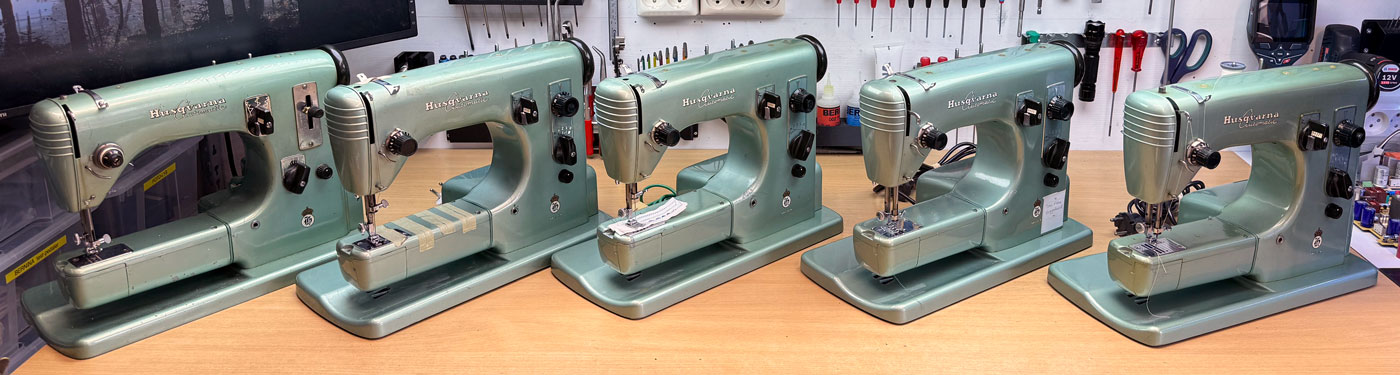
The most common problems with vintage sewing machines are caused by old and hardened grease, which causes mechanisms and switches to move slowly or seize. This is often misinterpreted as irreversible mechanical wear, even though it is actually a normal maintenance issue.
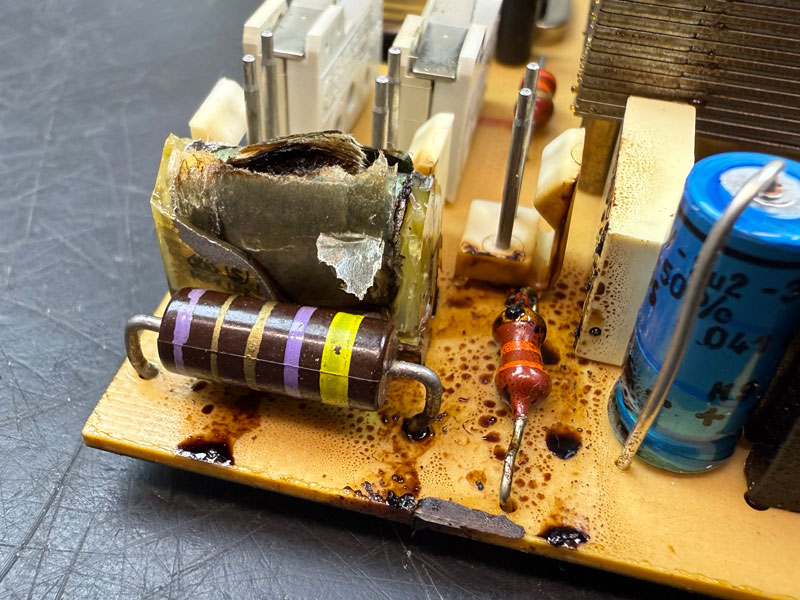
Symptoms such as a burnt smell, uncontrolled speed, or complete stoppage are often interpreted as a "defective motor", but in many cases are caused by a simple fault, such as a shorted capacitor.
Even after more than 50 years of use, the mechanics in these machines are normally in very good condition and have an expected lifespan of at least another 50 years. However, thorough restoration is required to restore function and safety.
We disassemble the machines as needed, clean the components in an ultrasonic cleaner, and replace defective parts with equivalent, approved components. Each machine is delivered in technically sound condition and in accordance with its original certified design.
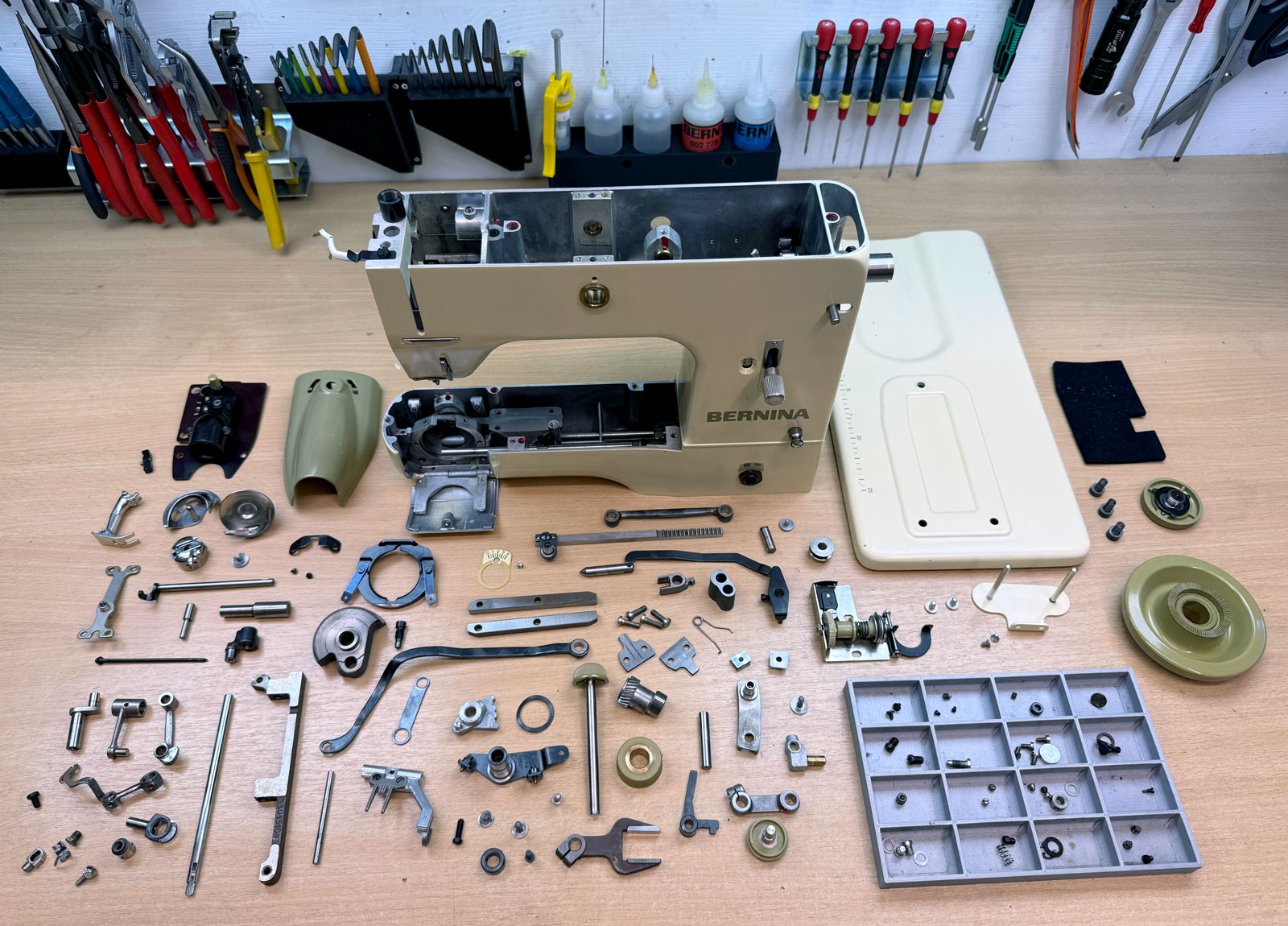
Restoration of a BERNINA 700 from 1962
We love the superior quality of vintage sewing machines and have dedicated our expertise to preserving and restoring as many of these fantastic machines as possible. We succeed in over 99% of cases (this also applies to sewing machines others have said cannot be repaired).
The reason is that these sewing machines were built extremely solid and 100% repairable, to last for many generations / at least 100 years. Many of them were delivered with a lifetime warranty.
Even though many of them have run for 40–50–60 years without a single service, the mechanics are as good as new after cleaning. For us, there is nothing to suggest that these machines will not function for at least another 50 years.
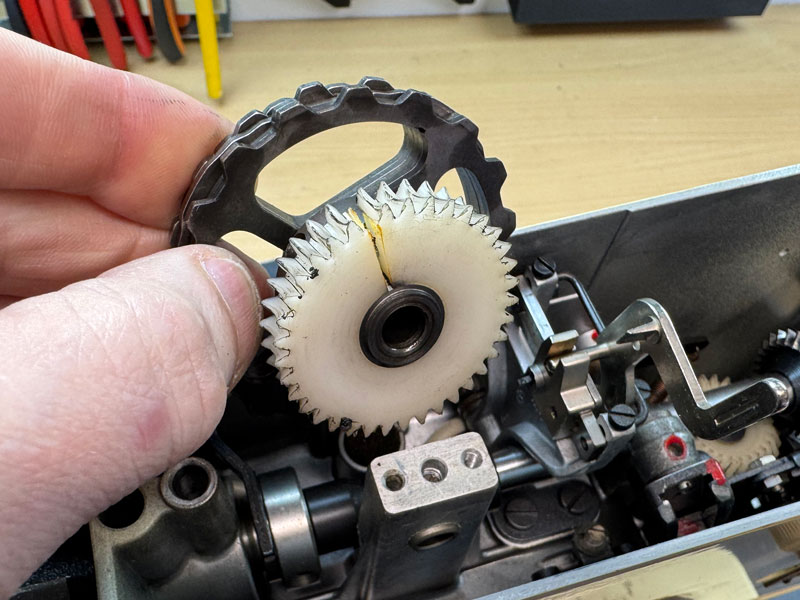
Many of the machines that come to us have already been somewhere else and have been told that they "cannot be repaired because parts are no longer available." The most common is the Husqvarna 2000 that needs a new slide or pattern cam. Another is the Bernina 730 that needs a new vertical gear or cam gear. These third-party parts are available on the market, in exactly the same quality as the original. For us, it is impressive that these machines only require a replacement once in 100 years.
We also repair sewing machine electronics and solve many issues ourselves with self-produced parts and improvisation.
Even though many of them have run for 40–50–60 years without a single service, the mechanics are as good as new after cleaning. For us, there is nothing to suggest that these machines will not function for at least another 50 years.
Many of the machines that come to us have already been somewhere else and have been told that they "cannot be repaired because parts are no longer available." The most common is the Husqvarna 2000 that needs a new slide or pattern cam. Another is the Bernina 730 that needs a new vertical gear or cam gear. These third-party parts are available on the market, in exactly the same quality as the original. For us, it is impressive that these machines only require a replacement once in 100 years.
We also repair sewing machine electronics and solve many issues ourselves with self-produced parts and improvisation.
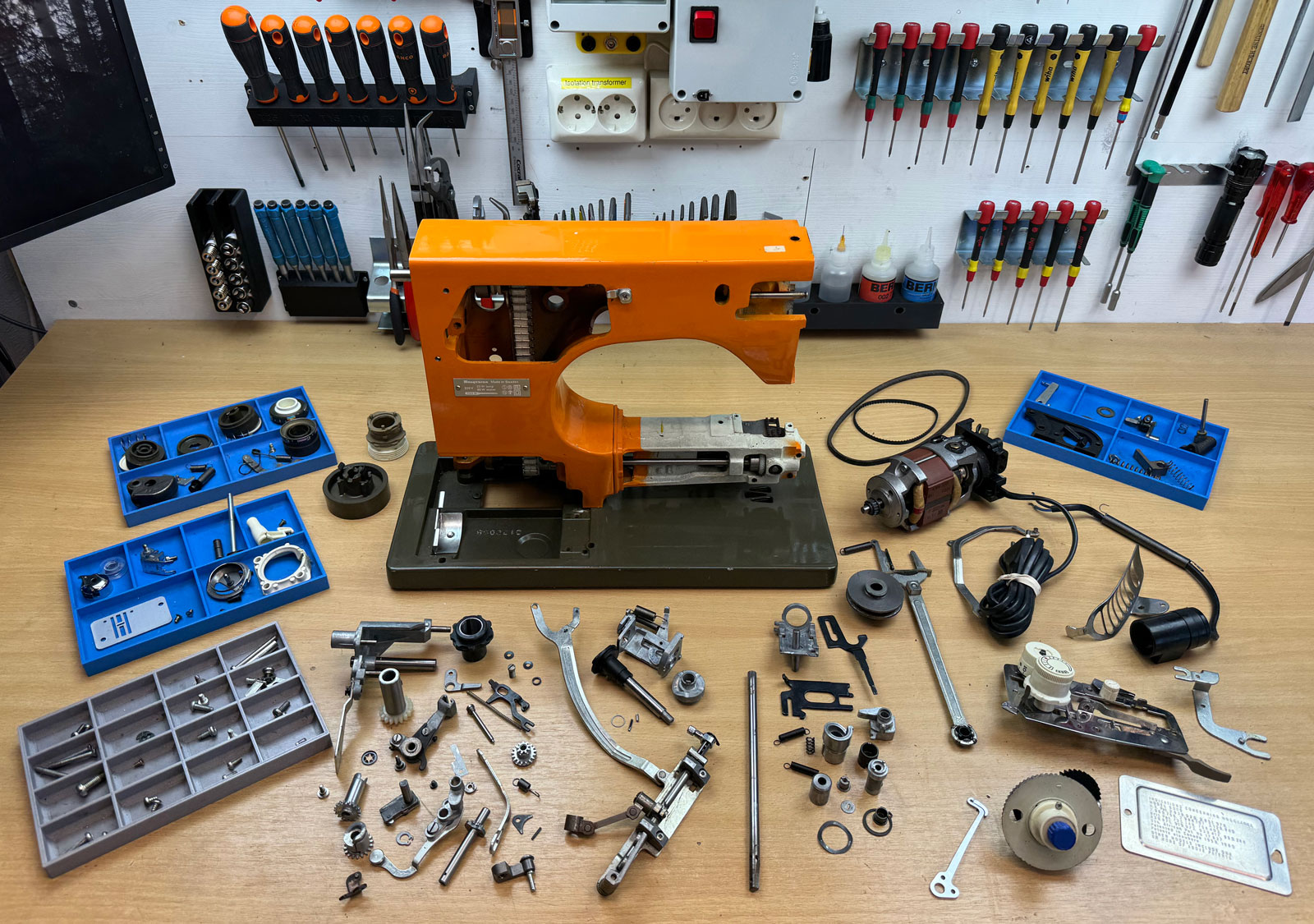
Restoration of a Husqvarna 6430 from 1977
It is often claimed that "it is not worth repairing old sewing machines because it is cheaper to buy a new one." That is not correct. A real comparison must be based on the cost of a new sewing machine of equivalent quality.
In 1964, top models such as Bernina 730, Elna Supermatic, Husqvarna 2000 and Pfaff 362 cost approximately NOK 1,700–1,900, equivalent to around NOK 24,000–27,000 today (Norges Bank). Such machines are no longer produced for the consumer market; equivalent quality is in practice only found at the industrial level.
Profitability is determined by technical lifespan, which in turn depends on repairability and manufacturer support. New sewing machines have low repairability, limited availability of parts (typically up to 10 years), and often built-in stitch counters with frequent service intervals.
The relevant question is therefore how many new machines – and services – are needed to match the lifespan of one old machine. Even if a full restoration of a Husqvarna 2000 were to cost NOK 10,000, it would still be more profitable than buying a new one.
Restoration of a Husqvarna 6430 from 1977
Profitability is determined by technical lifespan, which in turn depends on repairability and manufacturer support. New sewing machines have low repairability, limited availability of parts (typically up to 10 years), and often built-in stitch counters with frequent service intervals.
The relevant question is therefore how many new machines – and services – are needed to match the lifespan of one old machine. Even if a full restoration of a Husqvarna 2000 were to cost NOK 10,000, it would still be more profitable than buying a new one.
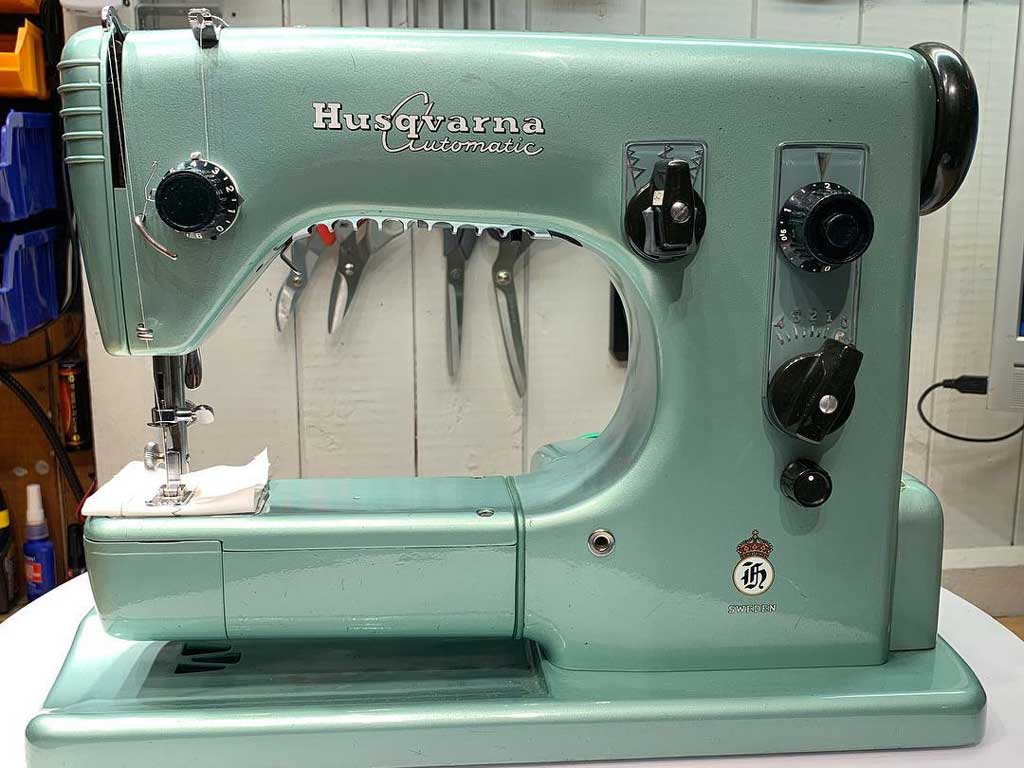
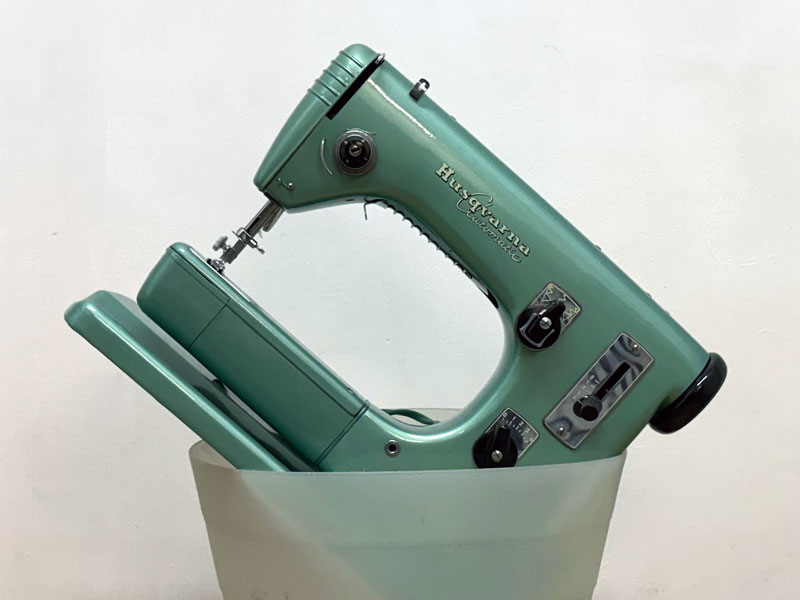
Husqvarna from 1961. Only reverse + defective cam.
New parts in stock.
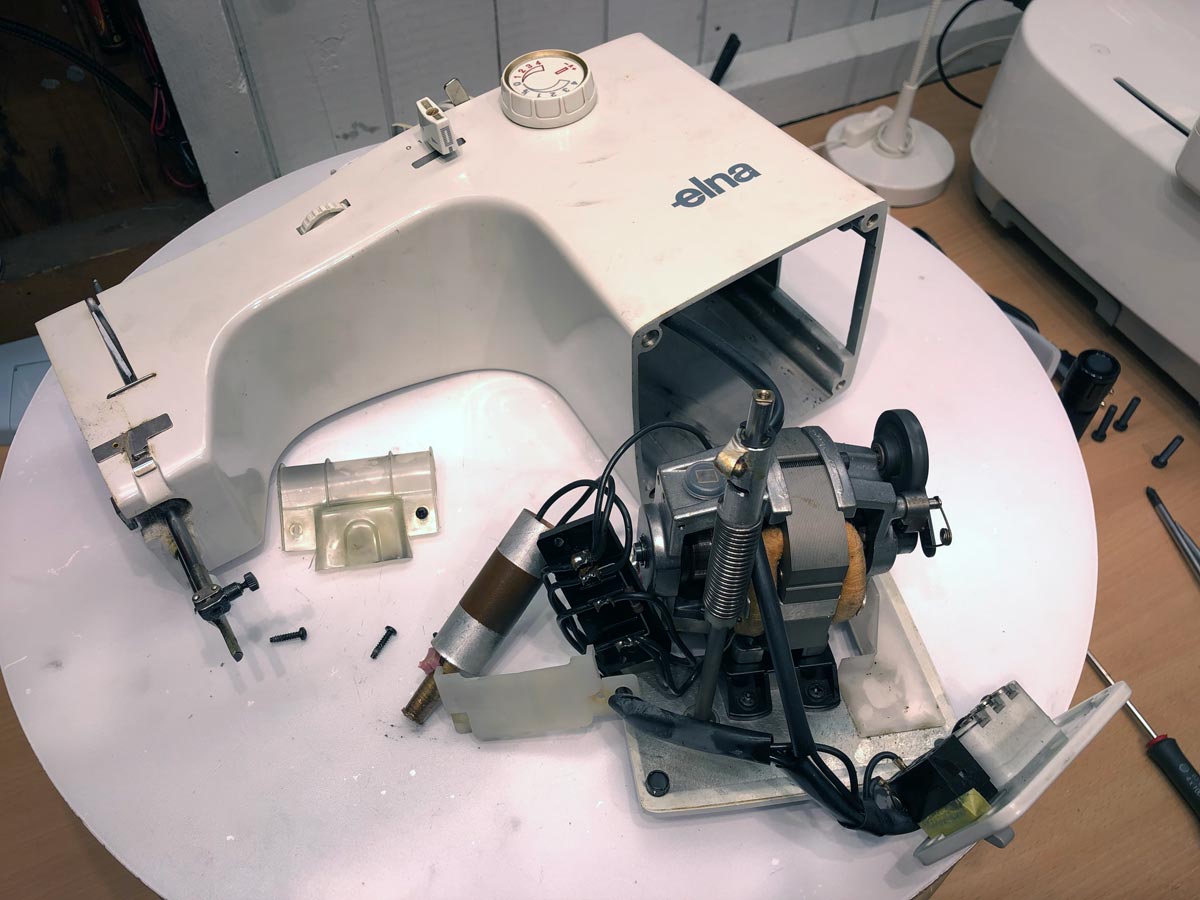
Elna from 1971 that was blowing fuses.
Replaced with new capacitors.
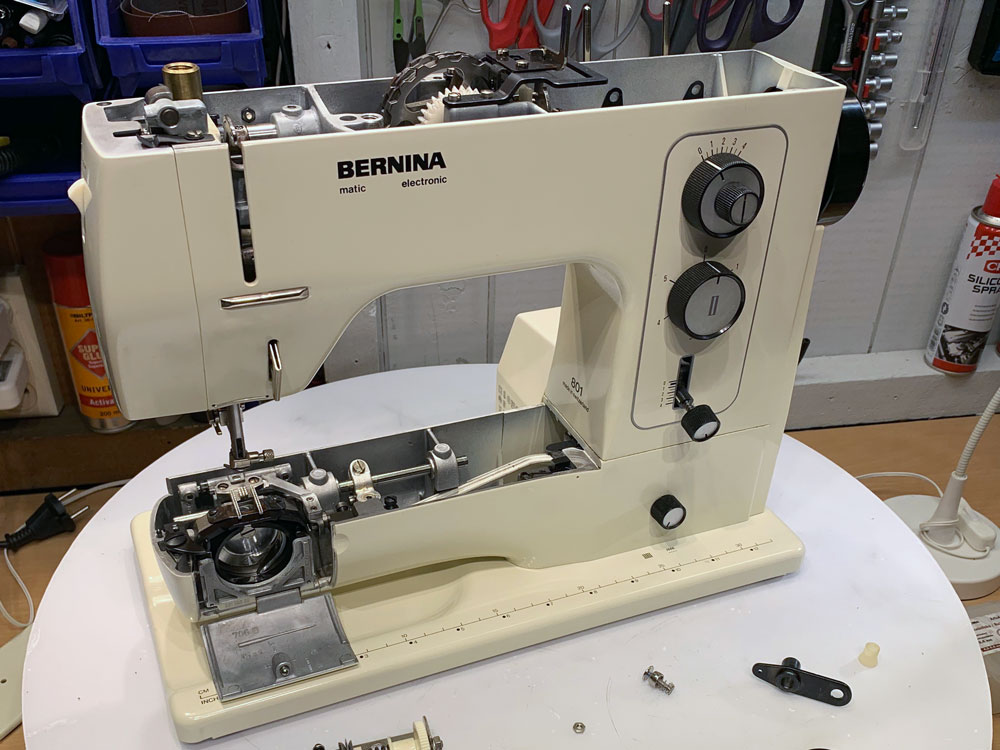
BERNINA 801.
Grease that had hardened and buttons that were stuck.
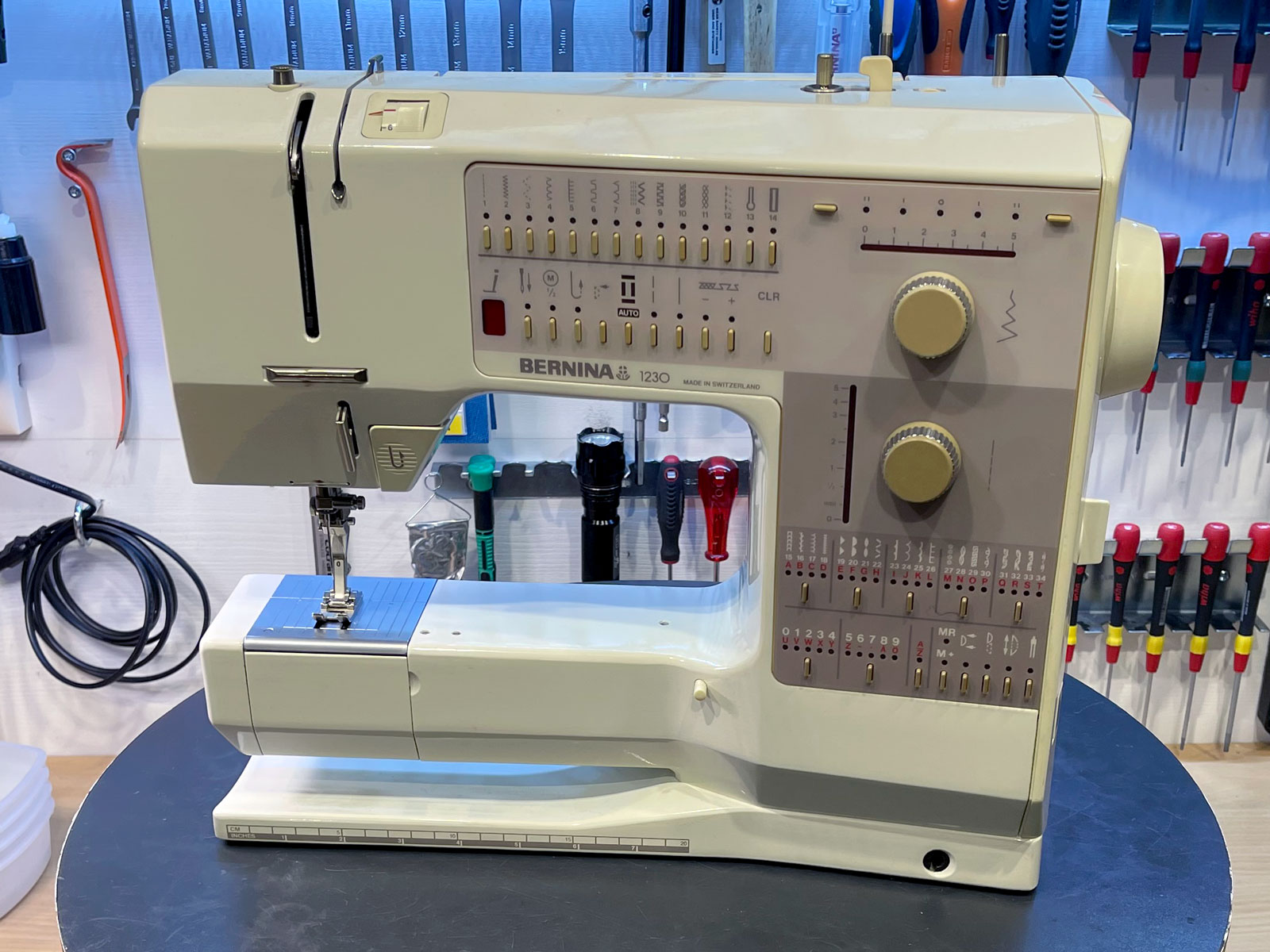
BERNINA 1230 with a defective power supply.
In 2019, humanity used renewable resources equivalent to 1.7 Earths. It speaks for itself – this is not sustainable. We feel a responsibility to contribute where we can, and our work in preserving and extending the lifespan of sewing machines is part of that.
Old sewing machines are made to last for generations, unlike many modern models. That is why it affects us every time we hear about solid and well-functioning machines that have been thrown away simply because it was believed they could not be repaired. For us, this is not just about getting a sewing machine to work again – it is also about the stories and memories that come with it. Many of these machines have been gifts for special occasions, family heirlooms, or faithful helpers over many years. Getting them working again gives us extra motivation – we are not just saving a machine, we are preserving a piece of someone’s history.

Organizes repair events and other great activities.
restartersnorway.no

Fix it yourself or find a repair technician.
tavarepadetduhar.no
We carry out thorough troubleshooting, repair, and service on most older sewing machines to ensure optimal function and lifespan.
Read moreWe give old sewing machines new life through professional restoration – both mechanical, electronic, and cosmetic.
Read moreWe have specialized expertise in troubleshooting and repairing electronic components and circuit boards in vintage sewing machines.
Read moreWe design and produce unique or discontinued spare parts so that machines that otherwise cannot be repaired can have a new life.
Read moreWe share technical manuals, troubleshooting guides, and tips for those who want to learn more or carry out simple repairs themselves.
Read moreIn the webshop you will find spare parts we manufacture, electronics repair kits, and useful products especially for older sewing machines.
Read more
Spare parts, electronic components, and other accessories for sewing machines are available in the webshop.
Special pricing and access to specialized tools for dealers and sewing machine repair technicians.
Here are some of our more than 140 Google reviews
5.0
You can easily do this by filling out the form on this page:
Book sewing machine service/repair
A completed booking is confirmed with a pop-up confirmation message on the screen and a text message sent to the phone number you provided in the booking.
We work in batches, meaning that we call in and complete around 20 machines at a time. The call-in will come after approximately 3 months, but when that happens we are ready for your machine and it will usually be completed within 1–2 weeks.
In the call-in message you will receive a delivery time period, usually within 2 weeks. The machine can then be delivered on one of our opening days. As long as you arrive Tuesday – Thursday, 11:00 – 16:00 during the call-in period, we do not need to know which specific day you will come.
Our opening hours are: Tuesday – Thursday, 11:00 – 16:00
The machine should be delivered with the power cord, foot pedal, bobbin case/bobbin, and a standard presser foot. Everything else can be left at home.
No! We only receive/return machines Tuesday – Thursday, 11:00 – 16:00
Yes! Send us an SMS or email and we will arrange a new delivery time. Those we do not hear from before the deadline will be removed from the waiting list.
We are experiencing an increasing number of phone inquiries to the technician regarding sewing machine-related issues. Therefore, we continuously work to protect the technician’s capacity for machine work rather than phone time.
On this page (syrep.no) and in the booking form we have tried to answer everything we consider relevant and that people typically ask us about.
If you have questions other than what we have already explained or answered, we are of course happy to help, preferably by email: post@syakademiet.no
- Many sewing machine problems are related to completely different or more complex issues than the owner perceives or describes in the booking.
- Even if it has been a short time since the last service, cleaning and lubrication before repair and fine adjustment are necessary in order to make proper assessments and stand behind our work.
Therefore, our policy of a minimum full service is well considered, professional, and non-negotiable: A cleaned and freshly lubricated machine (equivalent to a service) is the minimum starting point for carrying out qualified troubleshooting, repairs, and fine adjustments.
Our starting point is that almost all sewing machines and overlock machines can be repaired. We can give general advice based on experience, but it is impossible to say whether a machine can be repaired or what a potential repair will cost without physically inspecting the machine.
Those we do not hear from after the call-in (within the deadline) will be removed from our list. BUT a cancellation helps us keep our list organized and allows us to call in the next person faster. You can easily cancel at: syrep.no/minside
No, unfortunately not! The logistics and machine flow in and out are tailored to our working method, physical space/system, and total capacity.
Everything is set up to optimize our capacity, and this is not something we can compromise on.
All sewing machines are called in according to booking and fair order.
During a service, all covers are removed and the machine is vacuumed and blown clean. All necessary points are then lubricated or greased. The machine is checked and minor adjustments are carried out if necessary. The electrical system is inspected, faulty electronic components are replaced, and an LED bulb is installed if possible. The machine receives a new needle, is test sewn, and adjusted if necessary, for example the thread tension.
When the machine is finished you will receive a text message informing you that it is ready for collection.
SEWING MACHINE & OVERLOCK
Service/Repair/Restoration from NOK 2000
If the cost exceeds NOK 3000 we always call and present a price estimate.
EMBROIDERY MACHINE
Embroidery machine with 1 needle including embroidery unit from NOK 2950
Embroidery machine with 4 or more needles from NOK 4400
For larger embroidery machines the price depends on the machine type and the service/problem.
Prices include VAT.
TROUBLESHOOTING AND REPAIR ALWAYS INCLUDE A SERVICE
To perform troubleshooting and repairs on machines they must be cleaned and lubricated, equivalent to a service. This ensures nothing is overlooked and allows us to stand behind our work.
MAX PRICE - NO PRICE SURPRISES
To avoid extra time spent on phone calls we have set a maximum price that includes additional work related to service and possible minor repairs. If it becomes more expensive than this we will contact you.
In other words, you will not experience any surprises where the price becomes higher than expected.
PAYMENT
When you receive a message that the machine is finished you can pay from "My Page" with Vipps.
If you wish to pay when collecting the machine this can be done with Vipps or bank/credit card.
By agreement it is also possible to pay to account: 1822.47.44230 (payment must be received when the machine is collected).
Due to high demand we prioritize sewing machines and problems that are most difficult to have repaired in Norway. We therefore accept Bernina, Husqvarna, Pfaff, and elna machines manufactured before the year 2000.
In addition, we would like to help solve problems with other machines/issues that have been unsuccessfully repaired elsewhere.
No, unfortunately! We only accept machines that have been called in. You must wait to deliver the machine until you receive the call-in.
There are several things you can (and should) do yourself to keep your machine ready for use.
Clean the machine after use. How thoroughly depends on how much and what it has been used for (type of fabric). Brush away and/or vacuum the machine. Overlock machines that can open the cover on the left side can also be cleaned with compressed air.
Lubricate the moving parts you can access. The exact locations vary greatly from machine to machine, so check the user manual. Use a small amount of oil but apply it frequently. Lubricate approximately every 10 hours of use.
I have made several videos that help you thread your overlock machine.
Visit Syakademiet on: YouTube
Knowledge
Information
Opinions
AddressRælingsveien 21, 2010 Strømmen
Phone995 74 564
Emailpost@syrep.no
Pickup/deliveryTuesday – Thursday, 11:00 – 16:00